Nations as Moral Persons
Origins and Conceptuality
The Declaration of Independence opens with the all-too familiar words, “When in the course of human events, it becomes necessary for one people to dissolve the political bands which have connected them with another…” It would be easy to overlook the most important phrase in this opening: “one people.” In Jefferson’s original draft, he had described the Americans as merely “a people,” but after being edited by the Committee of Five and the Continental Congress, the phrase was changed to the more definite “one people.” While the revision was only one word, the change of meaning was profound. The founders were proclaiming that America was a single people, who, at the moment of declaring their independence from Great Britain, had united to form a nation as one united people.
A little over a decade later, in 1792, Jefferson, in his capacity as Secretary of State (1790-1793) under the Washington administration, wrote to George Hammond, the first British Minister (i.e., ambassador) to America. The occasion was the negotiations under the Jay Treaty (signed in 1794) in light of the French Revolutionary Wars and the ensuing conflict between France and Great Britain, and the all-important question of the role America would play (she managed to stay neutral). In the course of his letter, Jefferson negotiated with Hammond over the economic condition of the states, which had been devastated by the American Revolutionary War and were, in many ways, still struggling to recover. He argued that when a nation acts as a creditor to another nation, the individual members of the nation were responsible for the credit lent. Jefferson’s justification for this rationale was that “for a nation as a Society, forms a moral person, and every member of it is personally responsible for his Society.”
What did Jefferson mean by a nation being a “moral person”? Was this a common idea at the time of the American founding or an idiosyncratic reference by our most famed founder? As with most matters at the time of America’s founding, Jefferson and his colleagues were working within a long-standing tradition of Western political thought.
Origins: Plato
The only proper place to start in attempting to understand the idea of a nation as a moral person is with the beginning of Western philosophy itself: Plato. In the Republic, Socrates is famously debating Polemarchus, Thrasymachus, Adeimantus, and Glaucon about the nature of justice in the human soul. Since it is difficult to peer into the soul and discover justice there, in Book II, Socrates suggests to Adeimantus that they compare the soul of man to the city, because the city will be easier to investigate as it is bigger. “Perhaps, then, there will be more justice in the larger thing, and it will be easier to discern. So, if you are willing, let’s first find out what sort of thing justice is in cities, and afterward look for it in the individual, to see if the larger entity is similar in form to the smaller one” (369a).
The idea that the city is a reflection of the soul of man is a famous theme in the political writings of the Greeks. The rest of the Republic assumes this much, but as tantalizing as Socrates’ analogy is for scholars, he never elaborates on the nature of the relationship between the city and the soul of man. Behind the translation of “similar in form” is the Greek ὁμοιότητα ἐν τῇ ἰδέᾳ—literally, “the likeness in the idea.” In other words, in the idea of the soul, we find a likeness or resemblance of the city.
The concept of an “idea” or “form” of something is, of course, hugely important for Plato, as he believed the essence of a thing (its pure being) was found in its ideal form in the heavenly realm (i.e., intellection or noēsis), of which earthly things are a mere shadow or reflection (in an imperfect way). Plato first used eidos at the beginning of Book II when he spoke of a “third form/kind [eidos] of good” in reference to goods that are both intrinsically and instrumentally good (of which justice is). Behind the concept of eidos lies the idea of the appearance of a thing, or how it looks to the eye, even if the eye might be deceived. This clues us into a recurring theme in Plato’s writings: the relationship between seeming and being, or, that which seems to be the case at first blush might not in fact be. The search for true being thus becomes imperative for Socrates, for without moving from the outward appearance of a thing to discover its real nature, one can never obtain genuine philosophic knowledge.
The knowledge of justice in the human soul, then, requires moving beyond the idea or appearance of justice in the soul to discovering its true essence. This can only be done, Socrates tells us, by examining the city which resembles the idea of justice in the soul. Socrates does not tell us how the city resembles the soul, only that there is a likeness. Importantly, likeness is not identical to sameness; Socrates is not asserting (although he could have) that the city is the same thing as the soul—or that justice in the city is identical to justice in the soul. Yet they are similar enough that comparing them will be profitable toward discovering what justice is.
The Greek idea that there is an intimate likeness between the soul of man and the city hints at what a city itself might be without asserting it outright. Beyond merely a collection of individuals or the ideal arrangement of public offices, the Greeks strove in their political commonwealths to achieve homónoia, or political solidarity. This involved not only commonality in language, religion, law, and custom among the people of a city, but especially attempting—through a common paideia (education)—to cultivate in the city’s citizens common beliefs and opinions about a variety of things, but especially of justice. A city who’s people are divided in their opinion about justice is like a soul at war with itself; neither will last long.
Unlike Socrates, our search here is not for the true nature of justice, but like Socrates, we want to acquire true knowledge of what a nation is by moving beyond what appears to be to what actually is the case.
Vattel & Wolff
While the American founders were well acquainted with Plato and other Greek writers, and their political thought draws from them in certain regards, the inspiration for their discussions of the nation as a moral person comes not from the Republic, but from a Swiss philosopher who was their contemporary: Emer de Vattel.
Vattel was famous in his day for his lengthy and learned treatise, The Law of Nations (1758). In the Preliminaries at the beginning of the work, Vattel asserted the following about nations:
Nations or states are bodies politic, societies of men united together for the purpose of promoting their mutual safety and advantage by the joint efforts of their combined strength. Such a society has her affairs and interests; she deliberates and takes resolutions in common; thus becoming a moral person, who possesses an understanding and a will particular to herself, and is susceptible of obligations and rights (§1-2).
Vattel’s analysis of the moral and legal status and agency of nations followed Plato’s habit of analogizing the commonwealth to the individual. A “society, considered as a moral person, [is] possessed of an understanding, volition, and strength particular to itself, [and] is therefore obliged to live on the same terms with other societies or states, as individual man was obliged … to live with other men … according to the laws of the natural society established among the human race, with the difference only of such expectations as may arise from the different nature of the subjects” (italics added) (§11).
Thus, while Vattel argued that nations are moral persons who have agency, will, and understanding and possess rights and obligations like humans, he also admitted that the nature of the two were yet distinct. While Vattel does not explicitly elaborate further on the similarities or differences between natural persons and national persons, he does explain how the moral person of the nation relates to both civil magistracy (i.e., sovereignty) and public authority:
A nation while she acts in common, or in a body, is a moral person. …That moral person resides in those who are invested with the public authority, and represent the entire nation (ch. 11, §117)
A political society is a moral person inasmuch as it has an understanding and a will of which it makes use for the conduct of its affairs, and is capable of obligations and rights. When therefore a people confer the sovereignty on any one person, they invest him with their understanding and will, and make over to him their obligations and rights, so far as relates to the administration of the state, and to the exercise of the public authority. The sovereign, or conductor of the state, thus becoming the depositary of the obligations and rights relative to government, in him is found the moral person, who, without absolutely ceasing to exist in the nation, acts thenceforwards only in him and by him. Such is the origin of the representative character attributed to the sovereign. He represents the nation in all the affairs in which he may happen to be engaged as a sovereign (ch. 4, §40).
For Vattel, the people collectively—when they act in harmony and concert—constitute the moral person of the nation. Yet since continuous collective action is difficult without a sovereign to represent them (whether in an individual monarch, aristocratic body, or a council or assembly), the moral personhood of the nation is taken up by the civil magistrate who embodies it in their person and the affairs of the political office.
Vattel, of course, did not originate the idea of a nation as a moral person, for he quotes the eighteenth-century natural lawyer Christian Wolff (1679-1754) on this same idea. In his The Law of Nature and Nations (1740-49) and The Law of Nations Treated According to the Scientific Method (1749), Wolff had also argued that nations were moral persons, but he gives us further clues as to its nature. In the former work, Wolff contended that
nations or sovereign states being moral persons, and the subjects of the obligations and rights resulting, in virtue of the law of nature, from the act of association which has formed the political body,—the nature and essence of these moral persons necessarily differ, in many respects, from the nature and essence of the physical individuals, or men, of whom they are composed. When, therefore, we would apply to nations the duties which the law of nature prescribes to individual man, and the rights it confers on him in order to enable him to fulfill his duties,—since those rights and those duties can be no other than what are consistent with the nature of their subjects, they must, in their application, necessarily undergo a change suitable to the new subjects to which they are applied. Thus we see that the law of nations does not in every particular remain the same as the law of nature, regulating the actions of individuals (Preface, italics added).
Here we discover two important qualifications. First, the moral person of the nation comes into existence through an “act of association” that creates a “political body” (i.e., body politic); and second, the nature of this national person is different from natural persons, which is why the law of nations, while based upon the natural law, diverges from it in specific ways.
In his latter work, Wolff declared that “the whole nation may best be thought of in the likeness of a man, whose soul is the director of the state, but whose body is the subjects as a whole.” Continuing, the German philosopher asserted that “it will also be plain what sort of union there ought to be between soul and body, and how harmony may be established between soul and body, by determining the form of state, and that the bond of union is obedience of the subjects and mutual love of superior and subjects” (ch. 1, §30). Wolff also warned against thinking of nations as aggregates of individuals, and he also explained how they can be perfected:
We have often already warned, when we speak of a nation, that we are not thinking of the individuals singly who belong to a certain nation, but of all who constitute that nation taken as a whole, lest the duties which are due to man as man be confounded with the duties which are due to a nation as a nation. The nation is a moral person, and therefore ought to have a perfection of its own. Association turns a nation into a state, and since this is done with a definite end, the perfection of the nation must surely be determined from that (ch. 2, §174).
Nations as moral persons are constituted from acts of association, and they are then perfected when they achieve their ends of preservation and the common goals that the citizens and magistrates have agreed upon.
Suárez & Pufendorf
To understand the nature of these acts of association that bring about nations as moral persons, we must continue our journey back into early modern history, this time to Francisco Suárez (1548-1617) and Samuel von Pufendorf (1632-1694). Suárez was a famous Jesuit priest and philosopher of the School of Salamanca (sixteenth and seventeenth-century Scholasticism). In his treatise On Laws and God the Lawgiver, Suárez asked the following question: Where does the power and authority to make human law come from? His answer was that “the power in question dwells either in individual men; or in all men, that is to say, in the whole body of mankind collectively regarded” (bk. III, ch. 2, §1). After exploring both options, Suárez rejects the first and embraces the second, reasoning as follows:
We must say that this power, viewed solely according to the nature of things, resides not in any individual man but rather in the whole body of mankind. … The basic reason in support of the first part of the conclusion is evident … namely, the fact that in the nature of things all men are born free; so that, consequently, no person has political jurisdiction over another person, even as no person has dominion over another; nor is there any reason why such power should, in the nature of things, be attributed to certain persons over certain other persons (bk. III, ch. 2, §3).
In other words, the power to make human law does not reside in or spring from any one person. No single individual contains in himself the right or authority to legislate for the whole of the community—and if any individual did claim this right, Suárez maintained, there could be no good reason why it is true for him and not everyone else. Thus, Suárez concluded, this power must exist in mankind collectively.
Suárez does not stop there, however, for he insists that “in order that our argument may be better understood, it must be noted that the multitude of mankind is regarded in two different ways.” The first way, unsurprisingly, is that mankind “may be regarded simply as a kind of aggregation, without any order, or any physical or moral union.” This arrangement, Suárez contended, was insufficient for political life: “So viewed, men do not constitute a unified whole, whether physical or moral, so that they are not strictly speaking one political body, and therefore do not need one prince, or head.” On this view, any “political community” that consists merely of a grouping of individuals concerned solely with their private lives is not a people or nation or commonwealth at all, but something less (like an economic association).
Suárez instead opts for the second option, which is worth quoting in full:
The multitude of mankind should, then, be viewed from another standpoint, that is, with regard to the special volition, or common consent, by which they are gathered together into one political body through one bond of fellowship and for the purpose of aiding one another in the attainment of a single political end. Thus viewed, they form a single mystical body which, morally speaking, may be termed essentially a unity; and that body accordingly needs a single head. Therefore, in a community of this kind, viewed as such, there exists in the very nature of things the power of which we are speaking [of making human law].
Suárez concluded this section by insisting that this political body needs a government and magistracy in order to function as a unified being.
For it is impossible to conceive of a united political body without political government or disposition thereto; since, in the first place, this unity arises, in a large measure, from subjection to one and the same rule and to some common superior powers; while furthermore, if there were no such government, this body could not be directed toward one [common] end and the general welfare. It is, then, repugnant to natural reason to assume the existence of a group of human beings united in the form of a single political body, without postulating the existence of some common power which the individual members of the community are bound to obey; and therefore, if this power does not reside in any specific individual, it must necessarily exist in the community as whole (bk. III, ch. 2, §4).
While Suárez spoke of the “mystical body” of the political community—which is as close as he gets to the idea of a national “moral person”—it is really to Pufendorf that we owe our understanding of the nation as a moral person.
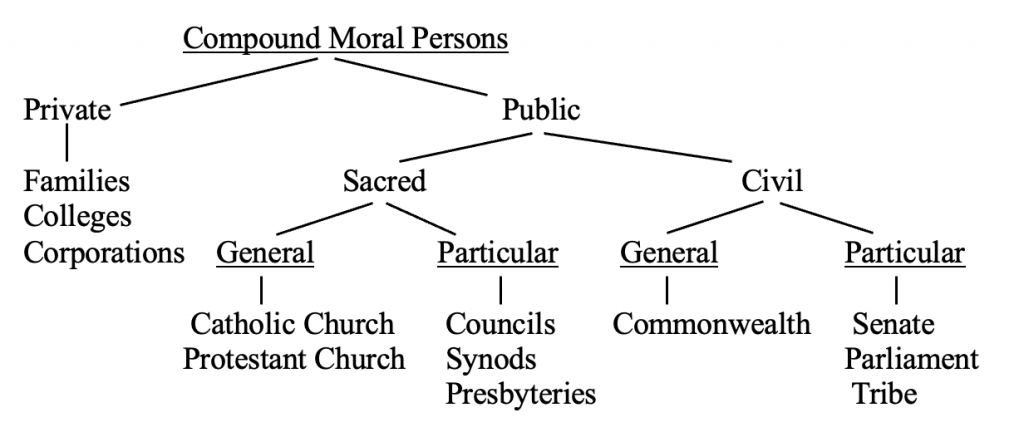
Samuel von Pufendorf was a German Lutheran theologian, philosopher, and lawyer. He wrote many books, but his most famous is The Law of Nature and Nations, published in 1672. In that work, Pufendorf discusses the origin and variety of moral entities. He distinguished between simple and compound moral persons. Simple moral persons are either private or public: private persons are individual citizens, while public persons can be divided into civil or ecclesiastical. A civil public person would be a representative, vicar, or the like.
What, then, is a compound moral person? “A Compound moral Person is constituted when several individual Men are so united together, that what they will or act by virtue of that Union, is esteem’d a single Will, and a single Act, and no more.” Pufendorf went on to say that this occurs when “particular Members submit their Wills to the Will of one Man, or of one Council, in such a manner as to acknowledge … for the common Act and Determination of them all, whatever that Man, or that Council shall decree or perform, in Matters that properly concern such an Union, and are agreeable to the end and intention of it.” The result, Pufendorf averred, was that “a compound Person doth and ought to obtain some particular Goods and Rights, which none of the Members, in their private and separate Quality, can claim or arrogate to themselves” (bk. I, ch. 1, §13).
Pufendorf also argued that the compound moral person of the nation was similar to the human body in that it persevered over time: “that as natural Bodies continue the same … so by the particular Succession of Individuals, the Identity of the compound Person is not injur’d”—unless, of course, the whole is destroyed all at once. Interestingly, Pufendorf did not limit the idea of the compound moral person to merely the civil or political sphere, but spoke of it as also properly denoting the sacred or ecclesiastical. Sacred compound persons included both the Catholic Church and particular (Protestant) churches, and even included ecclesiastical councils, synods, presbyteries, and so forth.
Pufendorf’s classification breaks down in the following manner:
Later, in chapter 2 of book VII, Pufendorf explored in more detail the nature and function of civil commonwealths—public, compound moral persons. Like Suárez before him, Pufendorf denied that a mere “multitude of Men” could be a compound body as it would consist of “many separate Persons, each of which hath his own Judgment, and his own Will to determine him in all matters that shall be proposed.” Pufendorf then explained how this multitude is turned into a moral person:
So that, on the whole, to join a Multitude, or many Men, into one compound Person, to which one genearl Act may be ascribed, and to which certain Rights belong, as ‘tis opposed to particular Members, and such Rights as no particular Member can claim separately from the rest; ‘tis necessary, that they shall have first united their Wills and Powers by the Intervention of Covenants; without which, how a number of men, who are all naturally equal, should be link’d together, is impossible to be understood (bk. VII, ch. 2, §6).
Pufendorf proceeded to explain in detail how this covenanting would work: all men covenant “each with each in particular” to “join into one lasting Society”; the covenant could be absolute (when all the members agree to submit to whatever form of government is later established by the majority) or conditional (with the right of any to dissent from the form of government established, in which case he would also forfeit the benefits of society); that in order to create this political covenant, “’tis requisite that all and each of them give their Consent”; that such a society prior to the creation of a form of government is but “the first Rudiments and Beginnings of a State,” but that is incapable of maintaining the safety of the public with a proper government; and that the formation of a government is decided by the major part and to which there cannot be dissent and the society preserved, for “they who entered themselves into the Society upon Conditions, unless they expressly consent to the Government resolv’d upon, shall not become Members of the new state, nor be concluded by the vote of the Majority.”
The third and final act of covenanting—first the Society, then the Government—requires the setting up of a sovereign.
After the Decree hath passed, to settle the particular Form of Government, there will again be Occasion for a new Covenant, when the Person or Persons, on whom the Sovereignty is conferred, shall be actually constituted; by which the Rulers, on the one hand engage themselves to take care of the common Peace and Security, and the Subjects on the other hand to yield them faithful Obedience; in which likewise is included that Submission and Union of Wills, by which we conceive a State to be but one Person. And from this Covenant the State receives its final Completion and Perfection (bk. VII, ch. 2, §8).
It is in the sovereign—and in the relationship between the sovereign and the people constituted as an exchange of protection for obedience—that the moral person of the nation has its expression. For the union of the wills and actions of the people must have an efficient representative. It is not that the sovereign by himself is the moral person; he is the animating agent and officer of a prior political union—the compound moral person of the people of the nation. (Pufendorf explained how the personhood of the sovereign is obscured in democracies but plainer and more visible in monarchies and aristocracies.)
Conclusion
It should not be lost on the reader that Pufendorf speaks of covenants primarily, and only refers to consent as the obvious instrument to affect a covenant. Covenants require oaths, both oaths of allegiance taken by the people and the sovereign oath to protect the people and uphold the commonwealth (in England this took the form of the coronation oath). Oaths, in turn, presuppose the existence of a Divine Being to whom one is finally accountable for the oath taken. Thus Pufendorf’s philosophy of political association presupposes and is undergirded by religious assumptions—by which we obviously mean Christian. Even purely civil covenants like that which constitutes a commonwealth and brings it into existence still borrow religious symbols and significance precisely because civil government—its origin in men’s association, its forms of government, its civil magistracy, and its moral personhood—are all a divine ordinance from God.