Christian Education and Our Future
Editor’s note: This essay is based on a talk delivered at the Redwood Christian School’s Annual Gala.
To chart a path for the future of Christian Education, we must first look to the past. Sixteen hundred years ago, a man named Augustine wrote a book called the Confessions. Many claim it is the first autobiography in the history of the world. He opens it by speaking to God, and the first real sentence of the book is this: “You have made us for yourself, O Lord, and our souls are restless until they rest in you.”
Everything that follows is a commentary on that one sentence. Our souls, left to themselves, are restless. That is the human condition. It is not a bug; it is a feature of being made in the image of God. You were made for something, and until you find it, you will not rest. Your children were made for something, and until they find it, they will not rest. And the whole question — the whole question of what kind of life, and what kind of world, we are building for ourselves and for our children — is whether our restlessness is going to find rest. Consider two restless men.
The first was a mathematics prodigy. He entered Harvard at sixteen, took his PhD at Michigan, and became a full professor at Berkeley by his mid-twenties. He looked at the world that was coming — the world of computers and networks and machines that think — and decided the work of human hands was a mistake. So he ran. He quit his job, moved to a cabin in the woods with no running water, and tried to live outside the machine. And when he could not escape it (because you cannot escape it), he began mailing bombs to the people he thought were building it. His name was Ted Kaczynski, the Unabomber.
This is not, I should be clear, an argument in favor of Kaczynski. He was a murderer. Remember, he is the first of two restless men we are exploring. He died in prison. But he was not a fool. He was not crazy in the sense most people assume. He was a brilliant man who looked at what was coming for our children and decided to seal himself off, and eventually to declare war on it. He would rather kill humanity itself than see the future arrive.
The second man is also a mathematician. Also brilliant. MIT this time. He looked at the same future Kaczynski saw — the world of machines that think — and came to the opposite conclusion. He decided to merge with it. His name is Ray Kurzweil, and he is one of the most influential computer scientists of the last fifty years. He takes somewhere over a hundred pills a day, because he is trying to live long enough to become biologically immortal. He has publicly said he intends to use AI to resurrect his dead father. On the surface, this might not look like a war against humans, and it is not Kaczynski’s war, but Kurzweil’s attempt to transcend what it is to be human by worshipping the technology, and by attempting to merge with the machine, is its own form of running away from the problem of being human. Kurzweil and Kaczynski are both restless in the Augustinian sense.
Two of the most brilliant men of the last century. Two men who saw the future more clearly than almost anyone. And neither of them was free. Neither of them was at rest. They were restless men who built restless worlds. And the world these restless men have built is the world our children are growing up inside.
These men were wrong, but they are not our enemies. We want none of what they are selling. We want none of the lives they are building. We want freedom — the capacity to use the technology rather than be used by it; the capacity to let our children walk into a future with confidence. If we critique them, it is, interestingly, not for either of their particular approaches to technology that we would disagree per se, but for the way they think of the shape of the future more generally. They were not Christians, and they lacked Christian hope. Therein lies the source of their restlessness.
We can then map them on a two-by-two chart. For or against technology on the vertical, with or without Christian hope on the horizontal. This gives us a sense of the direction we need to search in if we are to find rest in this life. To reject our technological world but retain Christian hope is, at best, something like the Amish. But what of the fourth quadrant?
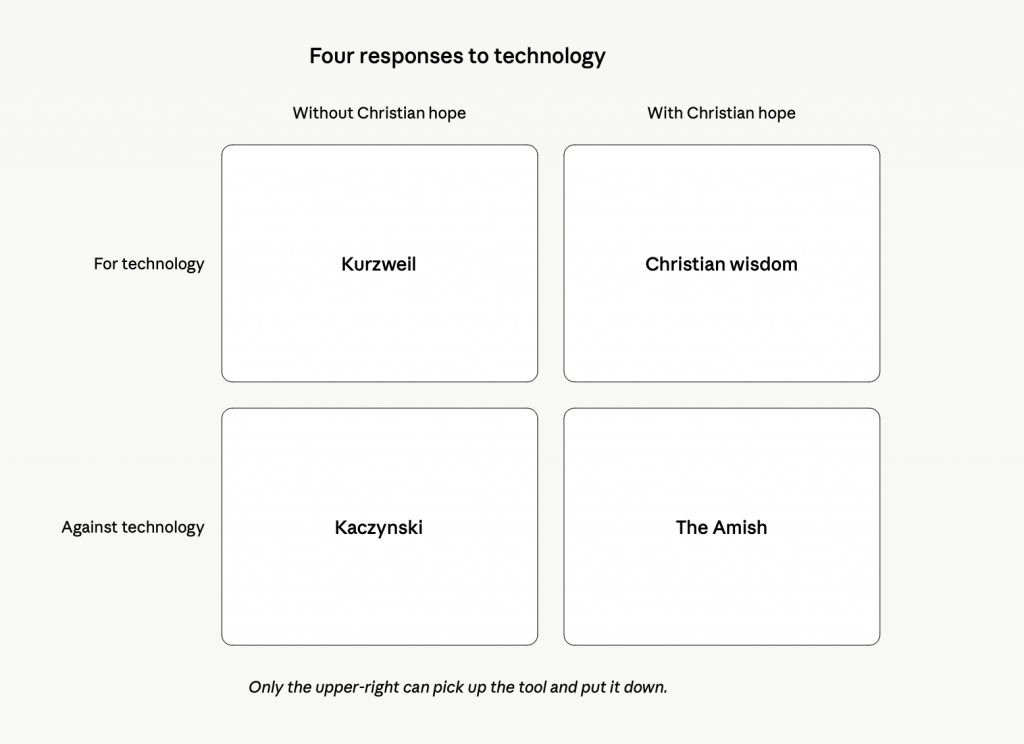
That fourth option is older. It is, in fact, the oldest option there is. And it is the option that brought every parent at Redwood Christian School to its doors. It informs the way we should engage in our accelerating, technology-driven world. That option is Christian wisdom.
Four hundred years before Augustine, there was a Greek philosopher named Aristotle. I will not lecture on Aristotle here. But there is one thing he figured out that most self-help books are still trying to catch up to: you do not become better at any activity merely by thinking about it. You get better by practicing. Over and over and over, until the right thing feels like the natural thing. He called this habit, and the acquisition of habit leads to character. Every person who has ever trained for a marathon, or learned to close a sales deal, or learned to play an instrument, knows this already. They did not think their way there. They practiced their way there.
Which means: whatever your child is practicing, all day, every day, is what your child is becoming. The phone involves a set of habits. Scrolling is a habit. TikTok is a habit — a habit of having one’s attention yanked somewhere new every nine seconds. But there are other habits, such as reading a book for an hour or memorizing a Psalm. Even simple things we often miss, like looking a teacher in the eye. These can be trained or untrained. But all the training in the world, on its own, cannot give you rest.
So we return to Augustine. Aristotle gets you most of the way there, and then he stops. Aristotle can tell you how to become something, but he cannot quite tell you what to become. He knows the point of our activity may be leisure, but can’t name the leisure himself. Augustine fills that in. Augustine reminds us: you are what you love. Every human being is a bundle of loves, and those loves are ranked. The project of a human life is getting those loves in the right order. Put God at the top, and everything else falls into place; the human creature, centered on God, can rest. Put anything else at the top — money, sex, success, safety, the approval of strangers on a screen, the well-being of your kids — and everything gets warped around that wrong center. Everything gets restless.
Aristotle gives us the how. Augustine gives us the what for. Put them together, and you have the definition of a real education: the ordering of a child’s loves and the habit of human excellence. Everything else (the math, the weightlifting, the biology, the robotics, the JV basketball) is downstream of that.
A public school education, at its best, can do the first half of that. It can give a child some habits. At its worst, right now, it fails even that. What it absolutely cannot do — what it has explicitly given up doing as a matter of policy — is the second half. It cannot order a child’s love of God, family, church, and country. It is not allowed to. It has said so out loud. Often, it actively seeks to malform a child’s loves with false flags and false gods.
Something appeared a week ago that speaks to this directly. The former senator from Nebraska, former president of the University of Florida, and a devout Christian, Ben Sasse, was diagnosed in December with stage-four pancreatic cancer. Ninety days to live. A week ago, he sat down with Ross Douthat at the New York Times. Douthat asked him what he thought about AI. About the future. About what is coming for his kids.
Sasse did not give the answer most people give. He did not give the answer Kurzweil or Kaczynski gave. He did not say AI was the apocalypse. He did not say AI would lead to heaven on earth. He said it was going to be both, for different people. For a small number of families, he said–families with intentionality, families with deep habits, families embedded in church communities, families that keep Sabbath–these new tools are going to be extraordinary. And then, in his own words: “For the majority of people, I think they’re going to be disastrous.”
Douthat pressed him. So, you’re telling me it’s eighty-twenty. Heaven for twenty percent, hell for eighty. What do we do for the eighty? And Sasse answered (from a man who knows he is about to meet God) with this: rank-ordered loves. Communities that order their loves correctly. Communities that can say no together. That was his answer. Which is, if you were listening, Augustine. Fifteen hundred years later, from a hospice bed.
Then Douthat asked him what advice he would give to a young father. Sasse did not hesitate. Honor the Sabbath. Protect the family dinner by keeping the screens out. There is a time to engage in the technology, and you will have time to make the most out of it. But you need to be someone first, someone real and substantial or the technology will make something out of you.
Which brings me to the framework we can use to become hopeful people who have what it takes to pick the technology up, and the wisdom to know when to put it down. Every Christian education — every serious one, ever — has to hold two places together. I call them the Font and the Forge.
The Font. Picture the baptismal font at the back of a church. It is the place where a child is named, where a child is claimed, where a child’s loves get ordered. The font is slow. It is face-to-face. It is physical books with weight. It is memorized poems and recited creeds. It is teachers who look students in the eye and love them. It is a long argument over lunch. It is silence. It is nothing plugged in. Nothing optimized. Nothing scrolling. In the font, a child becomes a self. This is, at the most profound depths, Augustinian.
The Forge. Picture a blacksmith’s shop with an older man swinging a hammer and a younger man holding the tongs. The forge is where that self, once formed, picks up the tools and makes something with them. The forge is loud. The forge is AI. The forge is Python. The forge is the video editor and the 3D printer and the spreadsheet and the spaceship your son will fly someday.
And here is the claim I want to make: you cannot raise a Christian child in one of these without the other. You cannot. Raise a child in the forge alone — surround him with tools and no formation, no ordered loves — and the forge will shape him instead of the other way around. The tool will make a tool out of your child. You will have raised a Kurzweil.
Raise a child in the font alone — surround him with catechism and sacred books and no tools — and he will arrive at eighteen beautiful and useless. And when the world touches him, as the world inevitably will, he will have no defense and nothing to offer. You will have raised an Amish at best or a Kaczynski at worst.
The whole project of a Christian school is holding these two together. Hours in the font. Hours in the forge. Never one without the other. There is something in Genesis that I think most of us skip over too quickly. In the second chapter of Genesis (before the fall, before Eve, before any of the drama starts), God makes a human, and the very first thing God asks the human to do is name the animals. That is the job description. Before anything else, poetry. Before anything else, language. Before anything else, the making of words for the making of the world.
Your child is in that image. You knew that from the moment they first looked you in the eye and said “mother,” “father”. Every child is a namer. And those same children are makers. Your child is a poet, in the oldest sense of that word — one who brings things into being by speaking them. That is not a metaphor, and it is not a flourish. That is what a human being is.
The question is not whether your child will make things. He will. The question is whether he will know whose world he is naming. Which, of course, requires that he first be able to know and name himself. You would be surprised how many students make it to adulthood restless and confused. A few years ago, I had a student in class who was convinced she was a boy. She had been convinced of it for a long time. It was the fixed point in her life. Everyone around her had accepted it. She had accepted it.
We were studying Aristotle, and the idea that things have an essence, a nature, and that a good life is one that runs with the grain of that nature rather than against it. That was it. That was the whole class. I was just a man at a chalkboard talking about a dead Greek.
She told me, months later, what had happened in that room. She said she had realized — sitting in that class — that she wanted to have a child someday. That she wanted to be a mother. And that the path she was on would make that impossible. She said she had been listening, for years, to voices from the machine telling her who she was supposed to be. And in that classroom, for the first time, she had put the phone down long enough to ask a different question: who did God make me to be?
She was baptized a year ago, and last week she got engaged.
Let me be clear about something. I did not do that. Aristotle did not do that. The school did not do that. That was God, speaking to a girl who — for one hour a day, a few days a week — was in a room where she could finally hear Him. That is what the font is for. Teachers who love their students enough to insist they put their phones down and listen. Listen in a quiet room. A quiet hour. Long enough to hear.
I want to take you back to where we started. Augustine said our souls are restless until they rest in God. That is the whole story. Everything else here is a footnote. Kaczynski was restless, so he ran to a cabin. Kurzweil is restless, so he is trying to achieve resurrection by way of a machine. Christian education exists so that the future can be formed by a community that knows how to rest in God, and from that rest knows how to master the machines of this world.
A heart at rest can pick up any tool the next decade puts in its hands. Any tool. AI, whatever comes after AI. We can pick it up. We can look at it steadily. We can use it. And we can put it down. Because our rest is not in the tool. It is in the One who made us.
That is the promise Christianity has always made to parents — the oldest promise there is: your child was loved and known before you ever met him, by the love that made the sun and stars. And you can rest easy knowing your child will be free.
Image Credit: Unsplash.