The Ethics of Political Rhetoric
The question before the house is whether political leaders can righteously threaten to commit evil acts in pursuit of legitimate political ends. The occasion for the question is, of course, President Trump’s recent posts threatening the Iranian regime. Here are the two most relevant instances:
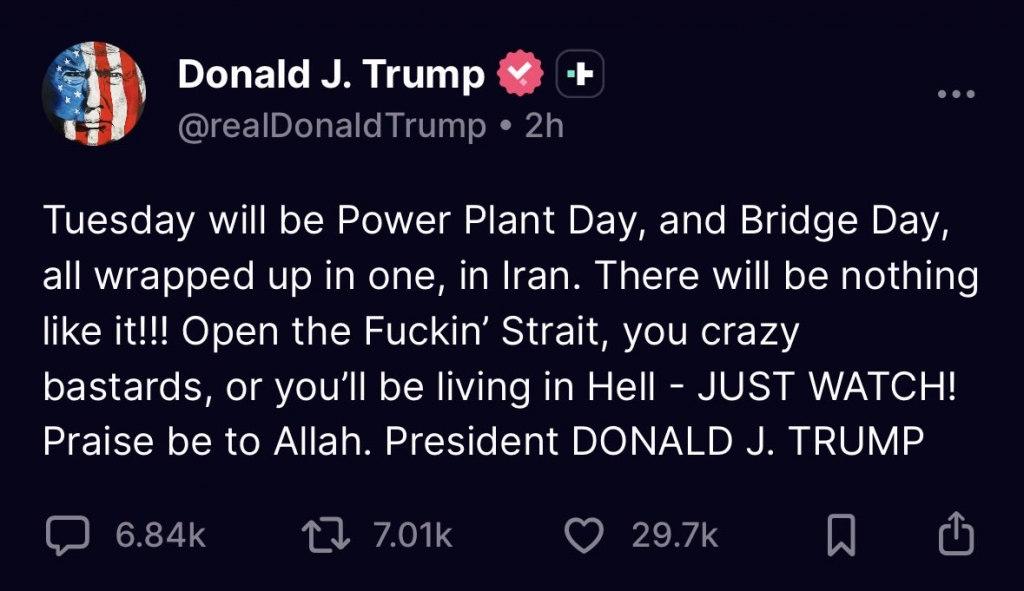
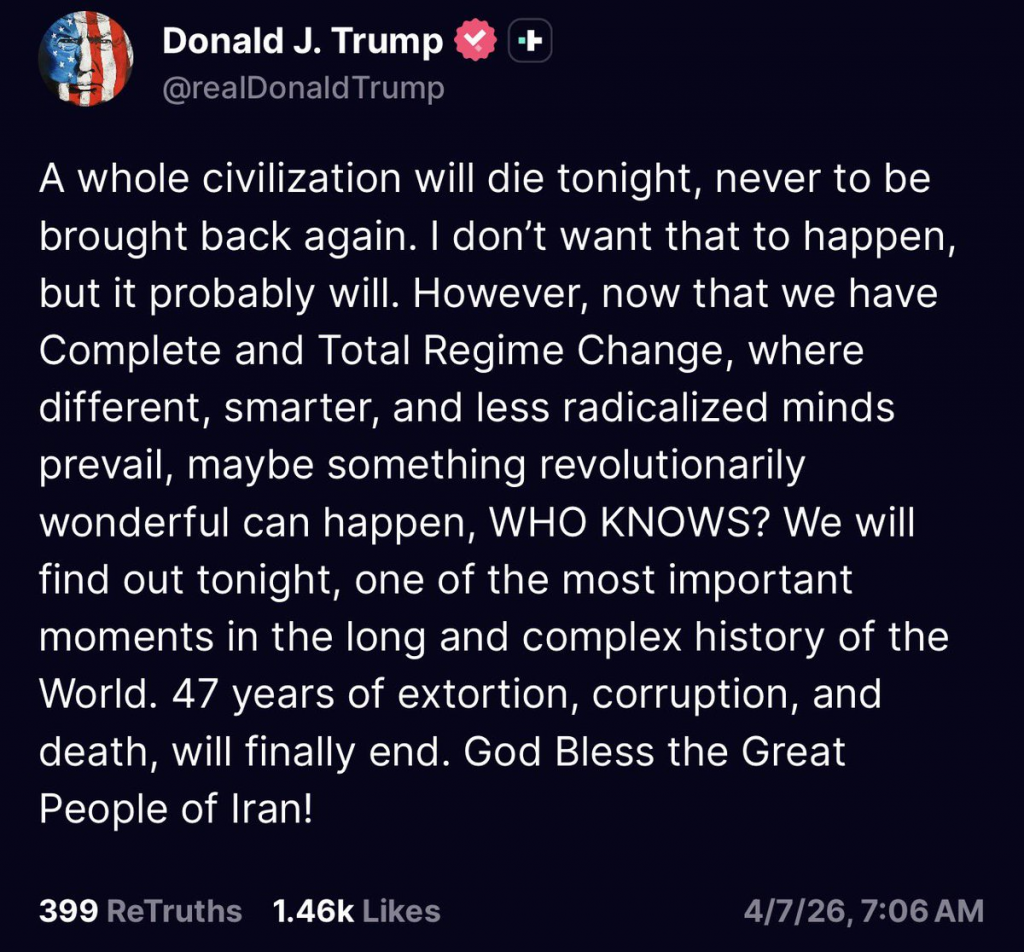
I write this essay a few hours after the second post, but prior to his 8pm EST deadline for some sort of action. (It appears a deal, facilitated by Pakistan, may be unfolding that will extend the deadline). I stress this for clarity’s sake, because I’m intentionally not addressing the President’s actions in relation to Iran (whatever those turn out to be). I’m interested in the rhetorical question: is it good and right for a leader to speak this way (setting aside as well the use of profanity in the first post)?
This, of course, is not the only time that the President’s words have raised this question. As others noted online today, Trump often embraces a “madman” persona as a negotiating tactic. He did memorably did this back in 2018 when he rhetorically asked someone to inform Kim Jung Un that his (Trump’s) nuke button was “much bigger and more powerful,” and actually works. I almost wrote this essay a few months ago when Trump was threatening to take Greenland “one way or another,” implying that military action against the Danish was on the table. The same might be said for the way that the President has threatened tariffs against other nations in order to induce them to cooperate.
Many Christians have expressed dismay at the President’s willingness to threaten evil actions, such as invading an ally like Denmark, or destroying the entire Iranian civilization. For the moment, I’m setting aside the question of whether bombing infrastructure like power plants and bridges would constitute a violation of just war principles. For the sake of argument, let’s say that such a bombing campaign would be a violation of just war conduct. What then? Is the mere threat of such a campaign morally wrong? Is it evil?
For some Christians, the answer is obvious. If the action itself is evil, then threatening to do the action is likewise evil. This is true, even if the President never follows through on the threat. The rhetoric itself is wildly inappropriate and reckless at best, and evil and wicked at worst.
It’s that claim that I want to explore and challenge in this essay.
The Mirror of Every Christian King?
Let’s begin by considering a Shakespearean example. Shakespeare’s Henry V depicts the titular monarch as “the mirror of every Christian king.” In particular, King Harry is a master of words. He ably parries the insults of the Dauphin in Act 1. He skillfully exposes the treason of his nobles in Act 2. He famously leads his men into the battle with his “Once more unto the breach” speech in Act 3. He encourages his beleaguered men in the night when they are outnumbered and surrounded and does the same with his nobles in the face of defeat with his St. Crispin’s Day speech in Act 4. And throughout it all, he gives all glory to God for the victory.
This is all well and good. But in Act 3.3, King Harry has a final parley with the governor of the city of Harfleur. In his address to the governor, Harry threatens to bury the city in ashes if they force him to renew the attack. No mercy will be offered. Instead, Harry’s rough soldiers “shall range with conscience wide as hell, mowing like grass your fresh fair virgins and your flow’ring infants.” He expresses his indifference to the potential rape of their maidens, since it will be the fault of Harfleur’s leaders who refused to surrender while Harry’s soldiers are in his command and the temperate winds of grace govern. He reiterates the threats a second time, painting a picture of bloody soldiers grabbing their daughters by the hair, their fathers by the beards and dashing them against the walls, and spitting their infants on pikes while their mothers howl to heaven. Indeed in a final flourish, he compares the looming devastation to slaughter of the innocents after the birth of Christ. Are we listening to King Harry or King Herod? “Mirror of every Christian king,” indeed.
But here’s the thing: it works. In the face of the threats, the governor of Harfleur surrenders. No more bloodshed. No maidens defiled. No infants on pikes. King Harry conquers the city…with his words. Horrific words, describing undeniably wicked actions. But the picture he paints is potent, and the men of Harfleur are at the very least unwilling to risk the wrath of the English.
Thus, it seems that Shakespeare at least regards the rhetorical threat of evil and horror as compatible with the virtue of the king.
The Surprising Wisdom of the Bible
But is Shakespeare a reliable guide in such matters? The Bard may be right that such rhetorical tactics are effective. But are they righteous? Is it morally upright and good for a king to threaten violence against the innocent?
Consider a different scene, one more familiar to Christian readers. Two prostitutes approach the king, one with a dead baby in her arms, the other with a live one. The former accuses the latter of inadvertently smothering her child and switching them in the night. The latter denies it. What is the king to do?
Answer: Call for a sword and threaten to divide the baby in half. Yes, Solomon too threatened violence against an innocent child. And as with King Harry, it works. The mothers reveal themselves, and the baby is spared.
Now at this point, someone might say, “But we’re not Solomon.” True. But the passage is clearly meant to instruct us in wisdom. In the previous passage, Solomon had asked God for “an understanding mind to govern your people, that I may discern between good and evil” (1 Kings 3:9). And God answers by giving him “a wise and discerning mind.”
In other words, the story of the prostitutes is not a Spirit-inspired, biblical suspension of normal morality. It is an exemplar of biblical wisdom, as Solomon brings God’s law to bear in an unforeseen situation. Solomon knows the law of God, and he knows something about the nature of mothers and their love, and the nature of grief and its bitterness. And his violent rhetoric is designed to call forth both the love and the grief in order to reveal the truth to the king.
So also with Harry. He knows something about war and its atrocities; he knows about the power of the imagination, and the fear of horrors. And his rhetoric is designed to paint a picture that awakens fear and horror and pity and affection, ultimately to induce the city to surrender.
Conclusion
From these two examples, I conclude that it is morally permissible for magistrates to threaten violence that it would be wicked to commit. Moreover, it seems that such threats must be credible in order to be effective; otherwise, we’re left with empty bluster.
Returning to President Trump, he himself has sketched precisely these sorts of rhetorical tactics in The Art of the Deal. His entire approach to negotiation involves gaining leverage, using publicity and shocking media headlines and controversy in order to gain favorable position. Wise negotiators seek to anchor high and apply pressure and urgency, asking for the moon while being willing to compromise. More than that, unpredictability is crucial to the President’s strategy. Like Nixon before him, the President wants America’s enemies (and friends) to be unsure of exactly how far he’ll go or what he’ll do. Will Harry really unleash his bloody soldiers? Will Solomon really cut the baby in two? Will Trump really destroy a civilization?
I make no claims about whether the President’s strategy will be effective. My own judgment is that President Trump is in danger of falling into the “Escalation Trap,” a military concept popularized by Dr. Ropert Pape (Pape provides an excellent overview of the concept in this interview). Nor do I have specific guidance on how to cultivate the credibility of the threat without committing evil. Those are not easy questions.
But regardless of its effectiveness, the President’s tendency to use unpredictable and over-the-top rhetoric, including threats of violence, is biblically and morally permissible as a way of achieving legitimate ends. We may debate the legitimacy of the present ends (my hope is that the President extricate us from this conflict and focus on our significant domestic challenges. We may debate wisdom and effectiveness of such rhetoric in any given instance; there are perils in multiple directions. But in principle, such rhetoric is part of the art of statesmanship. And so like Solomon, we ought to pray that President Trump and his advisors have discerning minds to govern this people and steer the ship of state through troubled seas.