From Its Inception, America Has Been An Imperial Power
President Donald Trump’s revival of the American imperial spirit has raised many questions about its relationship to the Christian voters who largely supported him in 2024. Certainly it was no secret that the second Trump presidency would bring a return to the muscular American role in a troubled world that he had pursued in his first term, unconstrained by a so-called “liberal international order” that was neither liberal nor orderly. During his first presidency, Trump withdrew from a host of useless international organizations and articulated an “America First” strategy.
Yet “America First” never meant “America Alone.” In addition to a range of initiatives to build new partnerships in Asia and the Middle East in his first term, Trump moved the American embassy in Israel to Jerusalem. This was a clear symbolic statement that the United States recognizes, indeed is part of, the messianic Judeo-Christian tradition of which the city is the center.
Christian voters, in other words, knew that they were voting for an imperial president in 2024. The question arises, then, as to how the renewal of the American imperial spirit comports with Christian values. Without dwelling on theological or philosophical issues, I want to argue that the Trump presidency is deeply influenced by the empirical values of Christian empire for the last 1700 years, going all the way back to Constantine, whose empire unified Christianity itself. Since discussions of Christianity and empire petered out a century ago as European overseas empires began to collapse, it is worth reconsidering the relationship in light of the revival of American imperialism under the Trump presidency. Is there a distinctly American way of Christian empire?
The distinctive aspect of Christian empire has always been its universalistic and improving temperament. Some empires, like Muslim empires, advanced a universalistic concept of man but were interested only in religious goals. Others, like successive Chinese empires, sought to improve local societies through trade but never abandoned a belief in a world permanently structured into a hierarchy of civilizations in which Chinese civilization sat on top. Christian empires retained the ethical imperative of material human betterment that came from the Jewish tradition, but abandoned its ethnic particularism, throwing open the doors to worldwide initiative. Christian imperialism has always been animated by improving the lives of others on the assumption that God calls us to action to combat evil and eliminate suffering. It is simultaneously animated by a sense of the divine equality of all peoples, which means that no part of the world is “off limits.”
It is at this point where critics scour the historical record to find instances where Christian imperialists acted in ways contrary to this universalistic and improving ethos. Indeed, Constantine’s first Christian empire can appear today to more closely resemble a Muslim empire in its focus on stamping out infidels and enforcing something like a theocracy. But with the rise of Christian humanism in the Middle Ages, the humanitarian aspects of Christian empire began to dominate. The archetype of the Christian imperialists was the Crusaders, whose forays into the Holy Land were welcomed by subject populations suffering under the cruel tyranny of local despots. Islam had no historical record of the Crusades (which they learned about from Christian histories) because the Crusader kingdoms allowed Muslims and Jews (who constituted most of their populations) to go about their business and were thus unremarked upon. A Muslim pilgrim who passed through the Frankish Kingdom of Jerusalem (1099-1291) – the first European colony — on his way back to Spain from Mecca observed that Muslims “live in great comfort under the Franks” and are “masters of their dwellings and govern themselves as they wish.”
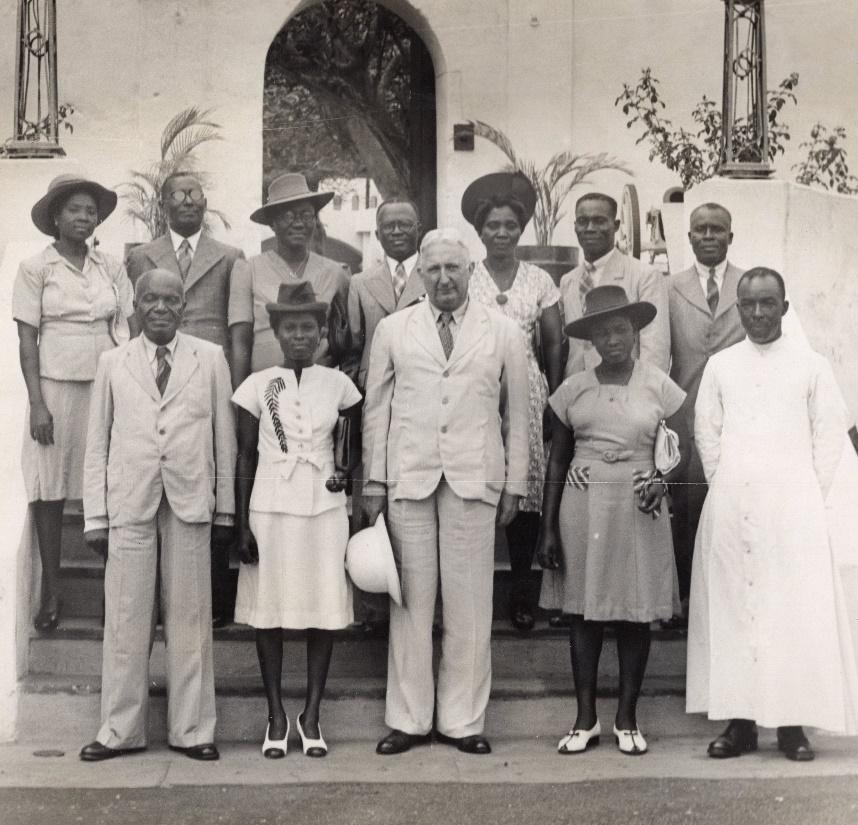
Critics of Christian empire insist that a faith based on love and equality can never countenance a system based on violence and inequality. True enough. But the claim merely reveals their profound ignorance about the nature of Christian empires, and the brutally violent and unequal societies that they replaced. The long era of European colonialism from the 1500s to the 1900s was ethically justified within a Christian framework of improvement and equality. It always displaced brutal, pre-modern ruling systems with something demonstrably better for individuals, which is why it spread so easily and successfully and lasted so long. I reproduce below a photo of the British colonial governor Sir Alan Burns (from my biography The Last Imperialist) attending church with locals while he was governor of the Gold Coast (today’s Ghana), as a reminder of the ways that Christianity has always been at the heart of Western empire.
The long era of European colonialism ended not because of native “resistance” but because European powers became exhausted by the costs of imperial rule. They packed up the moment any local jacquerie erupted. Until then, European colonialism fulfilled its Christian functions in making life better for tens of millions of people, through health systems, education, legal systems, anti-slavery campaigns, female emancipation, and economic development. Being a European colony left behind a developmental advantage that is still enjoyed today, according to a gold standard study of 2009 by the economists James Feyrer and Bruce Sacerdote. Another widely cited 2012 study by Robert Woodberry of the National University of Singapore found that the European colonies with intensive Protestant missionary activities were doubly advantaged in terms of their democratic prospects, even after taking into account other factors.
The Berlin Agreements on European colonialism in Africa, signed in 1885, institutionalized Christian humanitarianism on the continent, which opened the door for more intensive Christian missionary activities. Native interests were to be paramount in all colonial claims, and all powers agreed to have their records scrutinized. As part of that conference, the Belgian king, Léopold II, undertook the thankless task of trying to break up the various black and Arab slave empires and warlord dominions of the Congo River basin. The main criticism of his effort was that progress was too slow, even though life expectancy, population, and well-being improved dramatically in areas controlled by his state, a fact buried today under a mountain of false claims about “genocide” and other alleged brutalities that simply never took place.
From its inception, the United States was an imperial power. Indeed, a key reason for the revolution in 1776 was resentment at the king’s unwillingness to allow Americans to settle on the lands seized from the French in North America in a war that ended in 1763, leaving them instead to the primitive Indians and the morally suspect Québecois. The Declaration of Independence complained of how the king “has endeavored to prevent the population of these States; for that purpose obstructing the Laws for Naturalization of Foreigners; refusing to pass others [i.e. other laws] to encourage their migrations hither, and raising the conditions [i.e. tightening the requirements] of new Appropriations of Lands.”
The American experiment was seen in providential terms, a mission to the world where a Second Holy Land, or a New Jerusalem, would arise. The first proposals for the Seal of the United States, submitted by Franklin and Jefferson, featured Moses leading the chosen people. The most widely discussed pamphlet of 1776 was not Tom Paine’s secular and material Common Sense but the clerical and moral The Church’s Flight into the Wilderness. This meant that continental and then overseas expansion by the United States was always conceived in messianic terms, as a means to fulfill Christian obligations to improve the lives of others and to liberate people from systems based on human inequality. This included the war on the Confederacy, whose attempt to justify slavery long after the Protestant awakening of the 1700s was doomed.
If there was one thing that distinguished American colonialism and empire from its European counterparts in the 1800s, it was the concept of “Manifest Destiny”. First used to describe a belief in God’s plan for the Pilgrims to establish a most excellent form of government, it was later amended to include the spread of that form of government across the continent. This expansive version, coined in 1845 in The United States Magazine and Democratic Review, was animated by a new sense of what was happening in the western lands. In a nutshell, this new conception of Christian empire was radically egalitarian in its presumptions about the potential of all human societies to support democratic government. Up to that point, both New England liberals and Deep South racialists had doubted the ability of democratic government to take root among the mixed race populations of Indians, Mexicans, Italians, and barely literate whites of the new western lands, whom Ralph Waldo Emerson dismissed as “the off-scouring of civilized society.” What became the Christian destiny of American expansion was nothing less than an unwillingness to accept that history or culture was fate, and a sometimes naïve, but genuine, belief in the self-governing and self-organizing capacity of all peoples.
An important corollary of this was that there was, in theory, no limit to the territorial expansion of the United States. Early American leaders took it for granted that Canada would become part of the union, which is why it was pre-approved for admission under the Articles of Confederation. Most viewed Latin America as also destined to join the union. When Hawaii, Puerto Rico, and the Philippines unexpectedly fell into the lap of the United States, the only question was how quickly they could be prepared for self-government. The Philippines was given independence because the United States did not want to govern so distant a land. Hawaii and Puerto Rico, on the other hand, were retained as sovereign U.S. territory. Neither place has a serious independence movement today because life is so much better under the rule of the United States than it would be under any feasible alternative.
This is all essential background to the Trump presidencies. When the president talks of Canada, Greenland, Venezuela, or Cuba becoming the 51st state, it is nothing more than a revival of long-standing American belief in the potential universality of American empire. The first two need no explanation in terms of the radically egalitarian presumptions about the potential of all human societies to support democratic government. The latter two, on the other hand, require a distinctly American faith in human goodness and its potential for just government guided by Christian faith.
Central to the Latin American policies has been the Catholic tones of Trump’s second administration as a result of the unexpected confluence of a Catholic Secretary of State, a Catholic Vice President, and an American pope. Marco Rubio has been at pains to justify the administration’s muscular diplomacy in Catholic terms and has visited the Bishop of Rome twice to explain the actions of his Machiavellian prince. American Catholicism is, after all, closer to mainstream Protestantism than to European Catholicism in its democratic presumptions, which Leo himself previously espoused in his missionary work in South America.
Farther afield, American idealism has struggled in culturally alien societies. The Trump administration’s efforts to dislodge Iran’s Muslim theocracy presumed that the regime’s noxious character was limited to the elite. Yet its social roots run deep. Still, American occupations in Iraq after 9/11 and in Japan after World War II, both equally alien and non-Christian societies, left in place demonstrably more democratic regimes than they replaced. The test of success in Iran will be simply whether the Trump policies can nurture a regime that is less bad than the present one.
The Trump imperium also extends to domestic affairs. The Department of the Interior has promised to restore federal sites of historical significance to “solemn and uplifting public monuments that remind Americans of our extraordinary heritage, consistent progress toward becoming a more perfect Union, and unmatched record of advancing liberty, prosperity, and human flourishing.” It intends to remove descriptions that “inappropriately disparage Americans past or living.” This is a response to the “decolonize” movement that seeks to demonize and undo American continental expansion, always with a barely-concealed anti-Christian bigotry.
When Christians spread out across the New World, they were guided by several precepts intended to ensure that their expansion was consistent with Christian principles. The much-maligned “Doctrine of Discovery” of the medieval church, which granted sovereignty to any European power that discovered lands not permanently settled, was essentially a means to manage competing land claims. The doctrine forbade displacing established indigenous empires as well as the forcible conversion of natives. The problem, of course, was that by the time of the discovery of the New World, what indigenous empires had once existed were gone. The paltry North American population of natives was scattered across several competing and itinerant tribes and bands, often fleeing brutal incorporation by the last empires like the Iroquois or the Comanche.
The “hands off” approach of the Doctrine of Discovery competed with the more “hands on” approach derived from Christian universalism and charity. Standing on Plymouth Rock on the bicentenary of the Pilgrim landings in 1820, the prominent Boston lawyer Daniel Webster, later a two-time Secretary of State, insisted that American expansion had always been rooted in the Christian values that created a dynamic civilization capable of taking root anywhere because it contained “institutions of government, and institutions of religion: and friends and families, and social and religious institutions, framed by consent, founded on choice and preference.” This meant that the Christian values that guided the Pilgrims would invariably be extended to others. Pocahontas, the daughter of the Powhatan Confederacy chief, chose to remain living with the Pilgrims after being seized for leverage, preferring Christian society to her own. An 1840 painting of her Anglican baptism hangs in the Capitol Rotunda.
One might say that the United States cannot help but extend the hand of freedom to alien peoples. Yale historian John Gaddis argued that the factor which ultimately ended the Cold War, which brought untold freedom to millions in Eastern Europe and Central Asia, was the moral bankruptcy of the atheist Soviet regime in the face of the moral commitments of a Christian West led by the United States.
The Trump presidency may have disrupted many things in American foreign relations. But one thing it has not changed is the distinctly American approach to Christian empire. This egalitarian and optimistic spirit explains our country’s rise to greatness as well as its continued preeminence among nations despite more than half a century of predictions of decline.